
AARP Solitaire: The Classic Card Game That Never Gets Old
Some games earn their popularity through spectacle — big graphics, complex systems, constant updates keeping things fresh. Solitaire earned its popularity by being genuinely good at one thing and never stopping. Decades after it first appeared on home computers, people are still sitting down with a shuffled deck and working through the same familiar puzzle. AARP Solitaire on aarpsolitaire.org is a clean, well-made version of that same game, free to play in any browser without any of the usual friction.
What It Is
If you’ve played Klondike Solitaire before — and most people have, whether they knew the name or not — you already know the rules. Seven columns of cards, most of them face-down. Four empty foundation piles waiting to be filled, one per suit, running from Ace up to King. You move cards between columns in descending order with alternating colors, flipping hidden cards as you go, and draw from the stock pile when the tableau runs dry.
The goal is to get all 52 cards onto those foundations. Simple to explain, genuinely tricky to execute consistently.
What the AARP version does well is stay out of its own way. The interface is clean and uncluttered. Cards are large and easy to read. Controls respond well on both mouse and touchscreen. Nothing about the presentation fights against the experience of just playing the game, which sounds like a low bar but is surprisingly easy to get wrong.
Why It Still Works
Part of the answer is nostalgia. A huge number of people first encountered this game on a Windows computer in the 90s, and that early familiarity creates a comfort with the format that never fully goes away. Sitting down with a game of solitaire feels like returning to something known rather than learning something new.
But nostalgia only explains so much. The game holds up because the underlying design is actually good. Every hand is a self-contained puzzle with a clear objective and a set of constraints that create genuine decisions. Do you move this card now or wait? Do you draw from the stock or look for something you’re missing in the tableau? Is this sequence worth building here or does it close off something important later?
Those decisions are small, but they accumulate into something that keeps the brain quietly engaged in a way that feels productive rather than taxing. It’s stimulating without being stressful, which is a combination that’s harder to design than it sounds.

How to Actually Get Better
Most players who struggle with Klondike Solitaire are thinking too locally — responding to what’s directly in front of them rather than planning a few moves out. A few shifts in approach make a real difference.
Flip hidden cards early and often. Face-down cards are locked potential. Every one you flip adds options. Moves that reveal hidden cards are almost always worth prioritizing over moves that don’t, even when the alternatives look more immediately satisfying.
Don’t rush the draw pile. Drawing a card feels like progress but sometimes isn’t. Before hitting the stock, scan the whole tableau for moves you might have missed. Players who draw too frequently close off sequences that were still available.
Be careful with empty columns. An empty column is genuinely valuable — it gives you staging space to reorganize and creates flexibility that doesn’t exist otherwise. Filling it with the first King you see isn’t always wrong, but it’s worth pausing to think about which King would actually help you most.
Think about the foundation gradually. Moving cards up to the foundation feels good and looks like winning, but sending a card up too early can sometimes leave the tableau short of cards it needed. Build foundations steadily rather than rushing any single suit.
Accept that some deals don’t win. Not every shuffled deck has a solution, and spinning wheels on an unwinnable hand is a real time sink. If the board has been stuck for a while and nothing new is opening up, starting fresh is a legitimate choice.
The Practical Side
Aarpsolitaire.org runs the game directly in the browser with no download, no account, and no cost. It loads quickly, scales properly across desktop and mobile, and touch controls work cleanly on phones and tablets. There’s nothing to configure or set up. You open the page and you’re playing.
That frictionless access matters more than it might seem. A game you can start in five seconds gets played in moments that a more involved game wouldn’t — a short break, a few minutes between tasks, the quiet stretch before bed. Solitaire fits those gaps naturally, and removing every barrier between wanting to play and actually playing is the right call.
What It Does for You
Regular solitaire players tend to notice genuine improvements in pattern recognition over time — spotting available moves faster, anticipating problems earlier, building better intuition about which sequences are worth pursuing. The planning involved exercises working memory in a low-pressure way that most people find enjoyable rather than effortful.
The stress relief element is real too. The repetitive rhythm of moving cards, the quiet satisfaction of a sequence clicking into place, the absence of opponents or timers or any external pressure — it adds up to something genuinely calming. A lot of people use it as a way to decompress after a busy day, and it works for that purpose better than most things you could do with the same ten minutes.
Understanding the Tableau — Where the Game Is Actually Won
Most new players focus on the foundation piles as the goal and treat the tableau as just a means of getting there. That’s technically correct but practically backwards. The foundation fills itself naturally when you manage the tableau well. The tableau is where the game actually lives.
Seven columns, most of them hiding face-down cards you need to uncover. The visible cards are only part of what you’re working with — the hidden ones are what shape the whole game. A column with five hidden cards underneath it is a column that needs attention early, even if the visible card doesn’t seem useful right now. Those hidden cards could be the Aces and low cards you need to start building foundations, or they could be high cards that free up other sequences. You won’t know until they’re flipped.
The ordering rules — red on black, descending value — create a constraint that forces you to think about card placement rather than just card location. A red 7 can go on a black 8, but not on another red card regardless of value. When you’re choosing between two possible moves, the color and value relationships determine not just whether a move is legal but whether it’s useful — whether it opens something or quietly closes something off.
Empty columns deserve special mention again because players consistently underestimate them. When a column clears completely, you have a blank space that can hold any card temporarily or permanently. That flexibility is rare and valuable. The temptation to fill it immediately is strong, but an empty column held open while you work through a complicated section of the board is often more valuable than one occupied by a King that doesn’t unlock anything immediately useful.
Draw One vs. Draw Three — Which Version Should You Play?
AARP Solitaire typically offers both draw one and draw three options, and the choice affects the experience significantly enough that it’s worth understanding before you just pick one and stick with it.
Draw one flips a single card from the stock pile each time you draw. You cycle through the deck sequentially, seeing every card eventually. This gives you more information and more control — you can plan around what’s coming rather than hoping the right card turns up. It’s more forgiving and better suited to players who are still developing their tableau management.
Draw three flips three cards at a time, but only the top card of those three is playable. The other two are locked until the top one is used. This means large portions of the stock pile are inaccessible at any given time, and some cards might only surface once across a full cycle. Miss your window to use a card and you may not get another chance.
Draw three is the harder version, and it’s harder in a way that rewards the specific skill of thinking ahead. You have to plan around what you can access rather than what you can see, which is a meaningfully different cognitive task. Players who find draw one too predictable after a while often find that switching to draw three makes the same game feel genuinely challenging again.
Neither is wrong. Most players start with draw one, build their tableau instincts, and migrate to draw three when they want more difficulty. That’s a reasonable path.

Common Mistakes Worth Knowing About
Certain errors show up consistently across players at every level, and being aware of them is often enough to stop making them.
Matching whatever’s available without checking the consequences. The most visible move isn’t always the best one. Before placing a card, ask whether this move opens something up or just fills a space. Moves that don’t change the structure of the board in a useful way are often neutral at best and quietly harmful at worst.
Sending low cards to the foundation before the tableau is ready. It feels like progress. Sometimes it is. But a 2 or 3 sitting in the foundation when the tableau needs it to build a sequence is a resource that’s gone. The foundation will get filled — don’t rush it at the expense of the board.
Drawing repeatedly without scanning first. The stock pile becomes a crutch for players who haven’t fully developed the habit of reading the tableau. Before drawing, look at every visible card and every possible placement. The move you were about to draw past was probably already there.
Giving up too early on difficult deals. Some hands look unwinnable after ten moves and come together completely with the right approach. The instinct to restart when things look bad is understandable but worth resisting for a few more minutes. Difficult positions are often where the most interesting problem-solving happens.
How Solitaire Fits Into Different Types of Days
One of the reasons Solitaire has lasted this long is its flexibility — not just in session length but in what kind of mental state it suits.
On busy days when your brain is running hot from work or stress, a game of solitaire offers something genuinely different from scrolling through a phone or watching something passive. The light cognitive engagement gives your mind something to do that isn’t work, without requiring the kind of immersion that a movie or a complex game demands. It’s a middle ground that a lot of people find more restful than actual rest.
On slow days when you have more time and want something to do with it, solitaire scales up naturally. A longer session with careful attention to strategy is a different experience from a quick five-minute game — more deliberate, more focused, more satisfying when the board finally clears.
And on bad days, when nothing is going right and the to-do list feels overwhelming, finishing a game of solitaire provides something rare and genuinely useful: a small complete thing. A problem that had a solution, and you found it. That’s not nothing.
Solitaire and Other Classic Card Games Worth Knowing
If you enjoy AARP Solitaire and want to explore what else is in the same neighborhood, a few variations are worth trying.
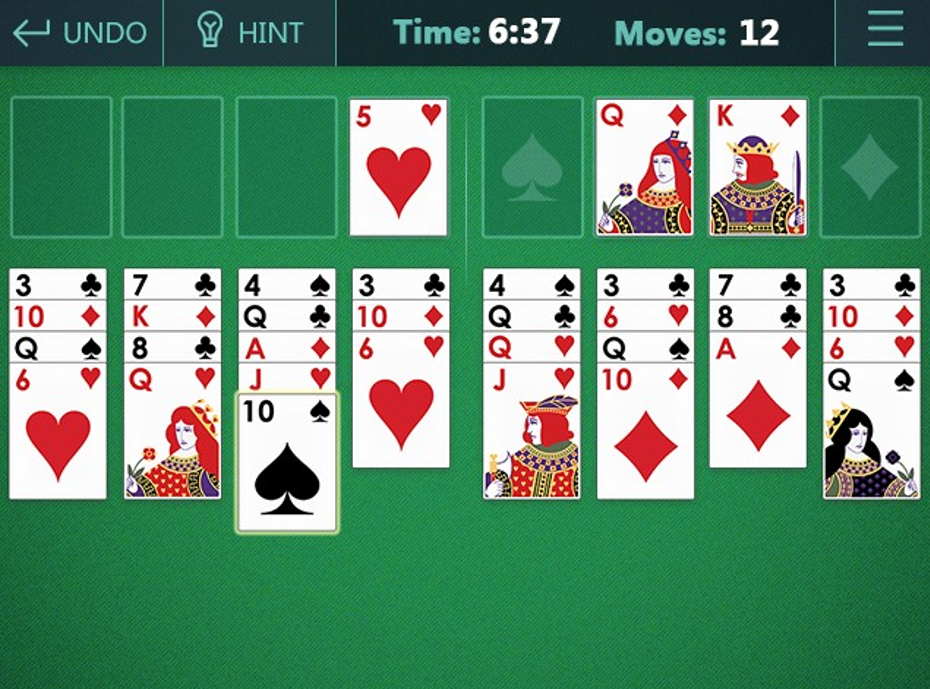
FreeCell is the most strategically demanding of the classic solitaire family. The entire deck is dealt face-up from the start — no hidden cards — and four free cells let you park cards temporarily while reorganizing. Almost every deal is mathematically solvable, which means losing is almost always a decision error rather than a bad draw. Players who find standard Klondike too luck-dependent often prefer FreeCell for exactly this reason.
Spider Solitaire uses two decks and builds complete suit sequences rather than alternating color sequences. The one-suit version is a gentler introduction; four suits is genuinely hard. It takes longer than a Klondike hand and rewards more sustained attention.
Golf Solitaire is faster and lighter — rounds take a few minutes, the rules are minimal, and the experience is more casual. A good option when you want something in the solitaire family but don’t have the headspace for a full Klondike game.
Pyramid Solitaire pairs cards that add up to thirteen, working through a pyramid layout. The rules take thirty seconds to learn and the strategic layer is lighter than Klondike. Good for a mental break without much warm-up required.
Each of these is free to play online, and trying a few of them gives you a better sense of what specifically appeals to you about solitaire — whether it’s the hidden card discovery, the sequencing logic, the pacing, or some combination of all three.
A Few Questions That Come Up Regularly
Is AARP Solitaire actually free?
Yes, completely. No account, no subscription, no in-app purchases. Open the browser and play.
Does it work on phones?
Yes. The mobile version is well-optimized and touch controls feel natural rather than like a port of a desktop game.
What’s the best way to start if I’ve never played?
Draw one mode, take your time reading the board before each move, and prioritize flipping hidden cards over building long sequences. The strategy develops naturally from there.
Are some deals impossible to win?
Yes. Not every shuffled deck has a solution. If you’ve drawn through the stock pile multiple times and nothing is moving, it’s fine to start a new hand.
How long does a typical game take?
Anywhere from five to twenty minutes depending on the deal and how carefully you’re playing. There’s no minimum or maximum — you play until you win or decide to move on.
Is there a way to practice specific skills?
The undo button is your best tool here. Use it not just to fix mistakes but to explore what would have happened if you’d made a different choice. Over time that kind of deliberate experimentation builds better instincts than playing more games without reflection.
Final Thoughts
AARP Solitaire doesn’t need to reinvent anything because the original was already good. What it offers is a clean, reliable, accessible version of a game people have been enjoying for decades — available instantly, on any device, without cost or hassle.
If you’re looking for something that’s genuinely relaxing, quietly engaging, and available whenever you have a few minutes to spare, this delivers exactly that. Some things stay popular because they’re genuinely worth your time. Solitaire is one of them.